

When you decide it’s finally time to save your old family memories, the first instinct for many is to look for a quick, DIY solution. A quick search online for a "vhs" converter often brings up dozens of plastic USB dongles priced between $15 and $30. They promise a simple way to handle your video transfer to flash drive at home. On the surface, it looks like a bargain. However, there is a hidden world of technical complexity behind analog video that these cheap consumer devices simply cannot handle.
At Scan A Lot, LLC, we believe that your memories: the first steps, the wedding toasts, the graduation ceremonies: deserve more than the bare minimum. There is a reason professional archives and broadcast studios don't use $20 adapters. Understanding the difference between consumer-grade gadgets and professional broadcast hardware is the key to ensuring your history is preserved with the highest possible fidelity.
The Fragile Nature of the VHS Signal
To understand why hardware matters, you first have to understand the nature of the vhs signal. Unlike digital files, which are composed of solid ones and zeros, analog video is a continuous wave of electrical impulses. Over time, the magnetic tape inside a VHS cassette degrades. The physical tape stretches, the magnetic particles lose their potency, and the mechanical timing of the recording begins to drift.
When you play a tape, the signal is rarely "clean." It contains tiny timing errors known as jitter. To a standard television, these errors might result in a slightly wavy line at the top of the screen or a momentary flicker. But to a computer trying to digitize that signal, these errors are catastrophic.
The Cheap USB Adapter: A "Dumb" Converter
The $20 USB capture cards found on major retail sites are what we call "bus-powered" devices. This means they draw all their operating power directly from your computer’s USB port. While this makes them portable and cheap, it significantly limits their capabilities.
As our internal research confirms, unpowered USB adapters lack the power delivery necessary to handle high-bandwidth data reliably. When a device is struggling to pull enough power from a laptop port, it often results in unstable performance. In the world of video transfer, instability means dropped frames.
A cheap adapter is a "dumb" converter. It takes whatever signal comes out of the VCR and tries to shove it into a digital format. If the signal from the VHS tape is weak or has timing errors, the cheap adapter simply loses track. The result? The video may stutter, the frames may skip, and most frustratingly, the audio and video will slowly drift out of sync. You might start a video with the sound matching the picture, but twenty minutes in, the voices are three seconds behind the action.
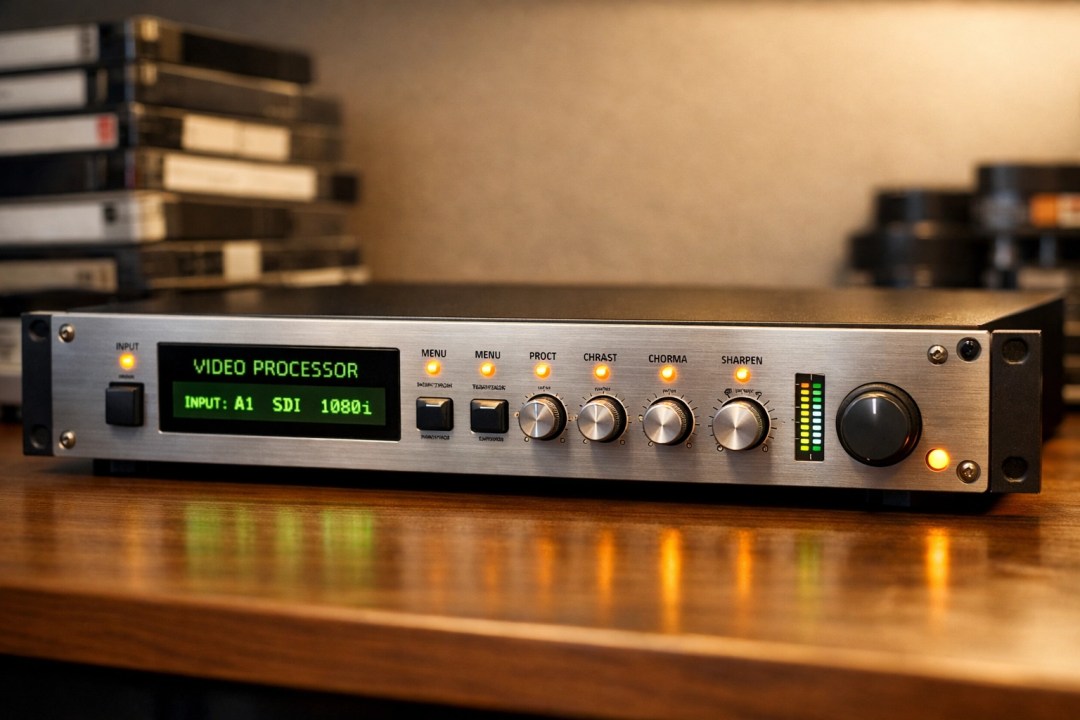
The Secret Ingredient: The Time Base Corrector (TBC)
The biggest secret in the professional video transfer industry is a piece of hardware called a Time Base Corrector, or TBC. You will almost never find a TBC inside a consumer-grade USB adapter. They are expensive, heavy, and require dedicated power supplies.
A TBC acts as a buffer between the VCR and the computer. It takes the "unstable" analog signal from the tape, breaks it down, and rebuilds it with a rock-solid digital clock. It ensures that every frame is exactly the right length and that the signal remains constant, even if the tape is physically damaged or old.
At Scan A Lot, we use professional, broadcast-grade TBCs. This is why our video transfer to flash drive service looks significantly better than a DIY attempt. Our hardware "cleans" the timing of the video before it ever reaches the digitization stage. This eliminates the jitter, stabilizes the image, and ensures that the audio remains perfectly synced from the first second to the last.
Professional Broadcast Decks vs. Consumer VCRs
The hardware difference doesn't stop at the adapter; it starts at the playback source. Most people who attempt a DIY transfer use an old VCR they found in the attic or bought at a thrift store. These are consumer-grade machines designed for convenience, not for high-fidelity extraction.
Professional broadcast decks, like the ones we maintain at Scan A Lot, are built with superior components. They feature:
- Industrial-Grade Video Heads: These heads are designed to read the magnetic information on a tape with much higher precision than a home unit.
- Advanced Transport Mechanisms: Professional decks treat the tape gently, reducing the risk of the machine "eating" your precious memories.
- Direct Outputs: Broadcast decks offer S-Video or Component outputs that bypass much of the internal noise-generating circuitry found in cheap home VCRs.
When you search for digitization near me, you are looking for someone who treats your media with this level of professional respect. Using a high-end deck combined with a TBC is the only way to capture the full range of color and detail that was originally recorded on that tape decades ago.
Why Bandwidth and Power Matter
The research into professional hardware shows a clear trend: power equals stability. Professional docks and capture stations use external power supplies to ensure that the heavy lifting of video processing doesn't fluctuate.
Cheap USB adapters often suffer from "electronic noise." Because they are small and poorly shielded, the electrical activity from your computer can actually leak into the video signal, causing horizontal lines or a "hum" in the audio. Professional hardware is shielded in metal housings and powered independently, ensuring the signal remains pure and isolated from the interference of a home computer.

The Scan A Lot Commitment to Quality
We know that when customers look for digitization near me, they are often overwhelmed by the options. It is tempting to choose the cheapest route, but video transfer is a "one and done" process. You want to do it right the first time so you never have to worry about it again.
At Scan A Lot, LLC, we use the same hardware used by national archives and major broadcasters. We don't cut corners with $20 dongles. Our workflow is designed to handle the most difficult tapes, from home movies to professional recordings. We stabilize the signal, eliminate the jitter, and provide a high-fidelity digital file that is ready for the modern era.
By choosing a professional service, you avoid the common pitfalls of DIY transfers:
- No more jittery, "bouncing" images.
- No more audio-video sync issues.
- No more lost frames or digital artifacts.
- The peace of mind that your vhs tapes were played on the best hardware available.
Your Memories Deserve Better
The technology used to record your memories was complex, and the technology used to save them should be even better. While the "cheap" route is enticing, the technical limitations of consumer USB adapters often result in a digital file that is a poor shadow of the original recording.
Scan A Lot, LLC provides a professional bridge between your analog past and your digital future. We take the "secret" tools of the broadcast world: the TBCs, the high-end decks, and the powered capture stations: and make them available to everyone. Whether you have one tape or a hundred, we apply the same professional standard to every video transfer to flash drive.
If you are looking for the best digitization near me, look no further than our expert team. We understand the science behind the signal, and we have the hardware to prove it.
Visit scanalot.photos to learn more about our process or to book your transfer today. Your memories deserve to be seen in the best light possible.
Explore more about our services:
#VideoTransfer #VHS #DigitizationNearMe #VideoPreservation #ScanALot #HomeMovies #ProfessionalEquipment #BroadcastQuality #FlashDrive #LegacyMemories #TipsAndTricks #Preservation