

Categories: Tips & Tricks, Preservation
A small film reel can hold more than a family holiday or a child’s first steps. Look closely at the background and there may be a corner shop that has long since closed, a school before it was rebuilt, or a neighborhood street before new homes and roads changed its shape.
That’s part of what makes old 8mm and Super 8 home movies so compelling. They were made to capture everyday life, not to document a town for the history books. Yet, decades later, those casual views can offer families a vivid glimpse of the places and people that shaped their lives.
More than a family movie
A camera might follow a birthday party, then drift toward the front yard. A parade recording might catch storefronts along the route. A school event could show the playground, the building, and the streets children walked to get there. In the background, the camera captures a hometown as it looked at one particular moment.
That’s often the magic of home movies: they preserve details nobody set out to preserve. A familiar building appears behind a family portrait. A local business is visible for just a few seconds. A ballfield, bus stop, church, or row of houses becomes part of the scene.
And the places are rarely separate from the people. The family members in the foreground may be standing outside a home that has since changed hands, waving from a front porch that looks different today, or gathering on a main street where the next generation now shops. The reel can connect personal memories to a shared sense of place.

Ordinary footage can hold local history
Home movies can complement official records by showing what a community looked like in daily life. Historical archives have found value in footage made by residents, including the South Side Home Movie Project, which preserves films shot by Chicagoans, and the Lynn Barnette Films of Mooresville, a collection of local footage documenting businesses, public spaces, and community events.
A family reel won’t tell the whole story of a neighborhood, and it may not identify every person or place. But it can give later viewers something a written record may not: moving images of ordinary streets, buildings, gatherings, and routines. When families share what they know about a location or the people on screen, those personal details can help make the footage more meaningful.
You don’t need to be a local historian to value these scenes. Sometimes it’s enough to watch with relatives and hear someone say, “That used to be the old school,” or “Your grandfather worked in that shop.” The reel becomes a starting point for stories that might otherwise stay unspoken.
The family story is in the details
The main street may catch your attention first, but the family moments give it heart. A child runs across the frame. Someone turns to greet a neighbor. Relatives gather on the steps of a house that no longer looks the same. Small gestures and passing expressions can make a decades-old scene feel surprisingly immediate.
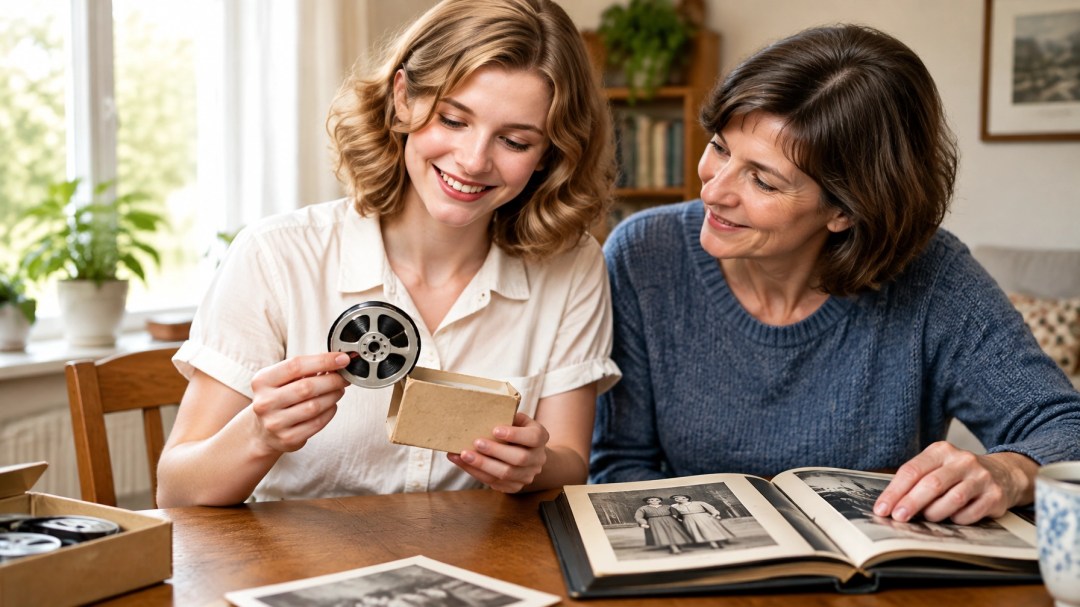
Watching together often brings out memories one person might not have recalled alone. A relative may recognize a face, name a business, or remember why everyone was dressed up that day. It can be helpful to keep original reel boxes, labels, and notes with the film: even a short handwritten caption may provide context that isn’t visible in the footage.
If people, dates, or locations are uncertain, that’s normal. You can still enjoy the film, and family members may identify more details over time. A digital copy is also easier to share with relatives who live elsewhere, making it possible for more people to contribute their memories.
Why consider 8mm film transfer now?
Film is a physical material, and its condition can change with age and storage. Some reels remain in good shape; others may have become more fragile. Because condition varies, the important first step is to have a professional assess the film before it is handled for viewing or transfer. A careful evaluation can help determine what approach is appropriate for each reel.
Digitizing film while it can still be handled safely helps make the footage easier to watch and share without relying on an old projector every time. The original reel remains an important artifact, but digital files provide a convenient way to revisit the images with family, on current devices, and in future years.
A transfer can also bring the footage into a more practical format for today’s households. Instead of needing to set up a projector, you can open a digital file, watch it with relatives, and share it with family members who could not be there in person. Those moments of recognition, spotting an old building or hearing a familiar family story, are often part of the preservation experience.
A thoughtful approach to old reels
Not every reel contains a landmark or a historic event. Some show a backyard, a family picnic, or a quiet walk down the block. Those scenes matter too. They offer a view of what everyday life looked like and can make a family’s history feel more tangible to children and grandchildren.
If you have a box of reels, it may be useful to note what you already know about them: approximate dates, family members, locations, or events. You don’t need to solve every mystery before seeking a transfer. Sharing any available context with the service provider can help keep the reels and their stories together.
Scan A Lot offers 8mm and Super 8 film transfer to digital, with each project handled with care. The resulting files are ready to watch and share, so family members can revisit the scenes and add what they remember. If you’re unsure about the format or condition of your reels, you can contact Scan A Lot with questions before getting started.

A hometown, seen through your family’s eyes
The town in an old home movie may be familiar, unfamiliar, or somewhere in between. A few seconds of a storefront might spark a conversation; a schoolyard might bring back a story; a street scene might show how much, and how little, has changed.
Those reels hold family memories, but they can also offer a glimpse of community life as it once was. With a careful transfer, that footage can move from a box on a shelf to a digital file your family can watch and share. The places may have changed, but the memories captured there can still bring people together.
#8mmFilm #Super8Film #8mmFilmTransfer #Super8Transfer #HomeMovies #FamilyHistory #LocalHistory #HometownMemories #FamilyMemories #PreserveMemories #FilmPreservation #MemoryPreservation #DigitizeFilm #FilmToDigital #HomeMovieDigitization #HistoricMainStreet #NeighborhoodHistory #CommunityHistory #FamilyArchives #GenerationalStories #TipsAndTricks #Preservation #ScanALot #ScanALotPhotos