

A box of VHS tapes can represent decades of birthdays, vacations, school events, weddings, holidays, and everyday family life. When you finally decide to preserve them, it is natural to wonder where to begin.
The good news is that you do not have to digitize every tape at once. A first batch can be a thoughtful starting point: one that focuses on the memories your family will most want to watch, share, and keep accessible.
When planning a VHS transfer to flash drive, the most helpful approach is usually to group tapes by occasion or family story rather than trying to rank every individual cassette from most important to least important.
Start with groups, not a perfect ranking
Trying to decide whether Tape 12 is more important than Tape 18 can quickly become frustrating, especially when many tapes are unlabeled or contain similar events. Instead, look at the collection as a series of groups.
You might begin with:
- Weddings and anniversaries
- Births and early childhood
- Birthday parties
- Graduations and school performances
- Family holidays and vacations
- Military service or career milestones
- Holiday gatherings
- Visits with relatives
- Annual family traditions
- Everyday footage from a particular period
Grouping tapes this way creates a natural viewing experience. It also makes it easier to decide on a first batch. For example, you may want to start with “Grandparents and extended family,” “The children growing up,” or “Family vacations from the 1990s.”
This approach takes some pressure off the decision. You are not making a permanent judgment about the rest of the collection. You are simply choosing a meaningful place to begin.
Lead with the moments that cannot be recreated
The most valuable tapes are often the ones that show people, places, and occasions that are no longer available to record again.
Consider starting with footage that includes:
- Loved ones who have passed away
- Relatives who are elderly
- Children at ages they have long since outgrown
- A family home, neighborhood, or business that has changed
- Weddings, reunions, and milestone celebrations
- A loved one’s voice, laugh, mannerisms, or stories
- A special trip or gathering that brought many relatives together
A short recording of someone talking at the kitchen table may become more meaningful over time than a professionally planned event. Home movies preserve more than the occasion itself. They capture the way people moved, spoke, laughed, and interacted with one another.
For families supporting someone living with dementia or Alzheimer’s, familiar video can also provide a comforting way to connect with long-term memories. Watching a familiar face or hearing a loved one’s voice may encourage conversation and reminiscence. Digital files are easier to play on a television or tablet than tapes that require an older VCR and a specific set of cables.
Notice tapes that may need earlier attention
Some tapes naturally rise to the top because of how they were stored or how they look. You do not need to diagnose a tape yourself, but it helps to point out anything unusual when you bring it to a professional service.
Set aside tapes that were kept in:
- An attic, garage, basement, or shed
- A space with high humidity or large temperature changes
- A box that was exposed to dust, moisture, or spills
- A location where the tapes may have been squeezed, bent, or dropped
Also make a note of cassettes with damaged cases, loose labels, visible residue, or signs that they may not have been stored in a stable environment.
At Scan A Lot, each tape is inspected by hand before it runs. This gives our team an opportunity to identify concerns, organize the project properly, and handle the original media with appropriate care. VHS tapes are processed on professional broadcast-grade equipment. Depending on the format, other family media may be handled with high-definition frame-by-frame scanners designed to capture as much detail as possible.
The goal is not to make the process feel complicated. It is to give every tape the attention it deserves before it becomes a digital file.

Expect a few surprises from unlabeled tapes
Many family collections include tapes marked with only a year, a first name, or a quick note such as “summer” or “Christmas.” Some have no label at all.
An unlabeled tape is not necessarily unimportant. It may contain an event that someone forgot about, footage from a relative’s home, or a few minutes of a family member who does not appear anywhere else in the collection.
You may also find that a tape does not match its label exactly. A cassette labeled with one occasion may include footage from more than one event. Some tapes were reused, so one section may contain a newer recording while an earlier or later section contains older material. There may also be extra footage at the beginning or end that was not mentioned on the label.
For this reason, it can be useful to keep unlabeled tapes in the first batch if they appear to be older, connected to an important period, or likely to include people who are no longer around. A professional transfer service can review the contents as part of the conversion process and help preserve what is actually there.
Think about how your family will watch the files
A successful VHS transfer to flash drive is not only about creating a digital copy. It is also about making that copy easy to use.
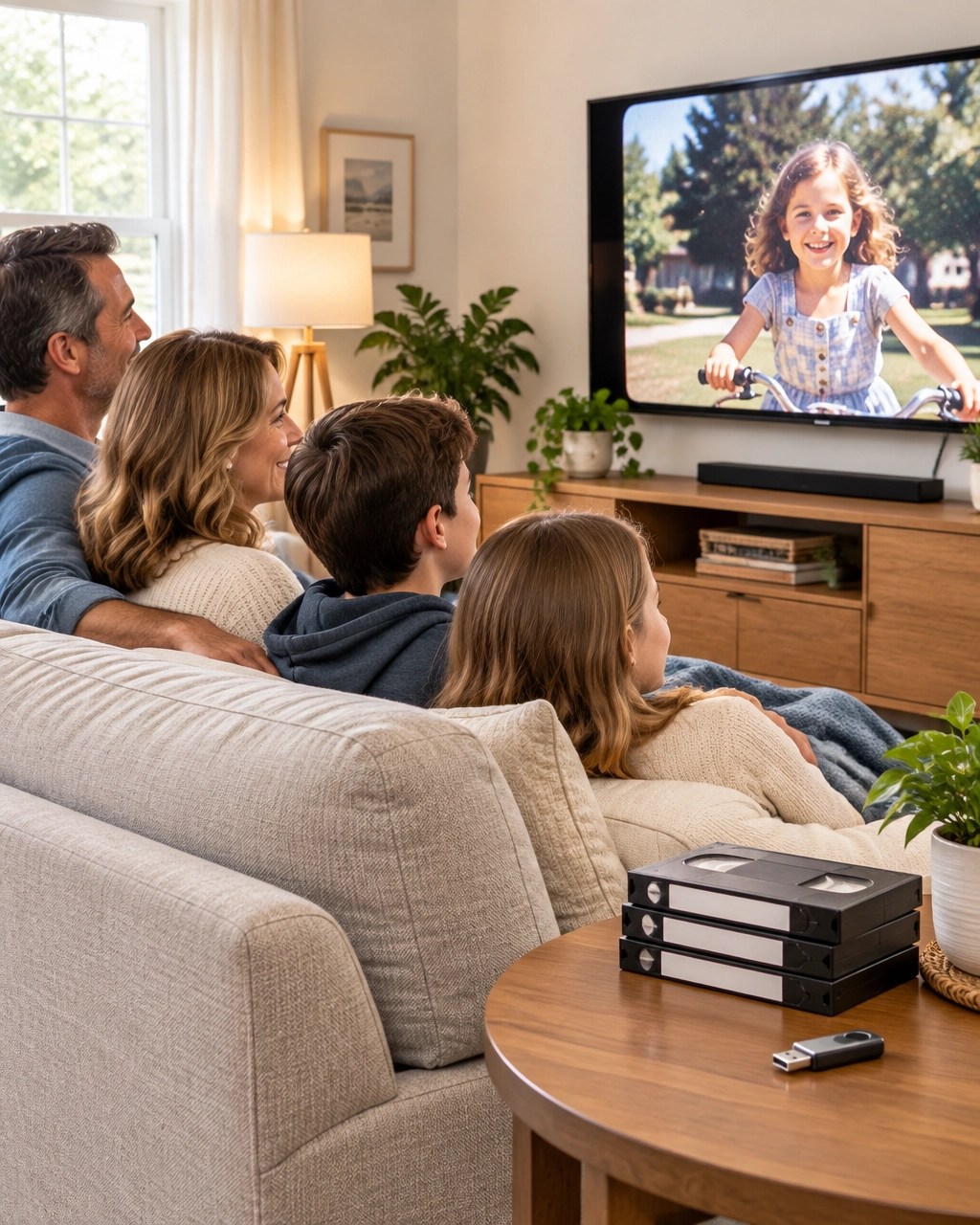
For many families, MP4 files on a flash drive are a practical choice. They can usually be viewed on a modern television with a compatible USB port or media player, opened on a computer, and shared with relatives. A flash drive also provides a simple physical format for bringing videos to a family gathering.
When the files are organized clearly, everyone can find what they want to watch. File names or folders might identify:
- The year
- The event
- The location
- The people featured
- The family branch or occasion
For example, a folder named “1996 – Family Reunion” is much easier to understand than one filled with files named “Video001” and “Video002.”
If your collection includes several occasions, you may prefer folders such as “Weddings,” “Birthdays,” “Vacations,” and “Grandparents.” The right arrangement is the one that makes sense to your family.
A flash drive should be viewed as a convenient viewing and sharing copy, not the only place your memories live. After receiving your files, consider keeping another copy on a computer, external drive, or secure cloud account. You can also share selected videos with relatives who live elsewhere.
A first batch can be small and meaningful
If you have a large collection, starting with five or ten tapes may feel more manageable than sending everything at once. Choose one group that tells a complete story.
For example:
- A wedding and the first anniversary
- Several tapes from a child’s early years
- A collection of holiday gatherings
- One family vacation
- Tapes featuring a parent, grandparent, or other relative
- A set of school concerts and graduations
Once those files are ready, you can watch them and decide what you would like to preserve next. Sometimes the first batch helps identify gaps in your labels or reveals connections between tapes. It may also make it easier for relatives to recognize what matters most to them.
There is no single correct order. The best first batch is the one your family will be glad to have available.
What to expect from professional VHS conversion
When you bring your tapes to Scan A Lot, we handle the physical media with care from intake through delivery. Each tape is inspected by hand before it runs, and the transfer is completed using professional broadcast-grade equipment. Our team works carefully with older media and creates digital files that are easier to access, watch, and share.
If your project includes photos, audio cassettes, slides, or film, those formats can be part of a broader family preservation plan as well. You can learn more about our VHS and video transfer services, flash drive options, and other media digitization services.
Searching for transfer to digital near me or digitization near me often means you want a service you can trust with original family memories. Local handling gives you the option to bring your first batch directly to our West Hempstead lab and speak with the team caring for your media.
Start with the memories your family will want to revisit
You do not need a perfect inventory before beginning. Gather the tapes, group them by occasion, look for the people and moments that cannot be recreated, and set aside anything that may have been stored in less-than-ideal conditions.
Then choose a first batch that feels meaningful.
Bring your tapes to our West Hempstead lab, or ship them with our secure kit. To discuss your project, call 844-722-6749 or visit scanalot.photos. We will help you preserve, digitize, and share the home movies that matter most.
Categories: Tips & Tricks and Preservation
#VHSTransferToFlashDrive #VHSConversion #TransferToDigitalNearMe #DigitizationNearMe #HomeMovies #DigitizeYourMemories #ScanALot #PreserveYourMemories #VHSToDigital #VideoTapeConversion #HomeVideoTransfer #FamilyMemories #FamilyHistory #MemoryPreservation #LegacyPreservation #DigitalMemories #ModernMedia #FlashDriveStorage #MP4Files #FamilyVideos #WeddingVideos #BirthdayVideos #FamilyReunions #VacationVideos #GrandparentsMemories #ReminiscenceTherapy #DementiaCare #AlzheimersSupport #PreserveThePast #ShareYourMemories #LongIslandBusiness #WestHempstead #MediaConversion #AnalogToDigital #DigitalArchiving #VideoPreservation #HomeMoviePreservation #ScanToDigital #PreservingFamilyHistory #MemoriesForGenerations #FamilyLegacy #OldVHS #VHSFiles #DigitalFamilyArchive #KeepTheMemories #AccessibleMemories #SafeMemories #ProfessionalMediaConversion #PreciousMemories #FamilyStory #PreserveAndShare