

Categories: Tips & Tricks, Preservation
A family interview can hold more than names, dates, and remembered events. It carries the sound of someone pausing to find the right word, laughing at an old family joke, or describing a place as they remember it. Those details make a cassette recording feel personal: it preserves a story in the speaker’s own voice.
If you have cassettes of relatives sharing family history, a professional audio cassette digitization service can make those conversations easier to listen to and share today. At Scan A Lot, we handle audio recordings with care and convert cassette tapes into digital files, helping families keep these firsthand stories accessible for the future.
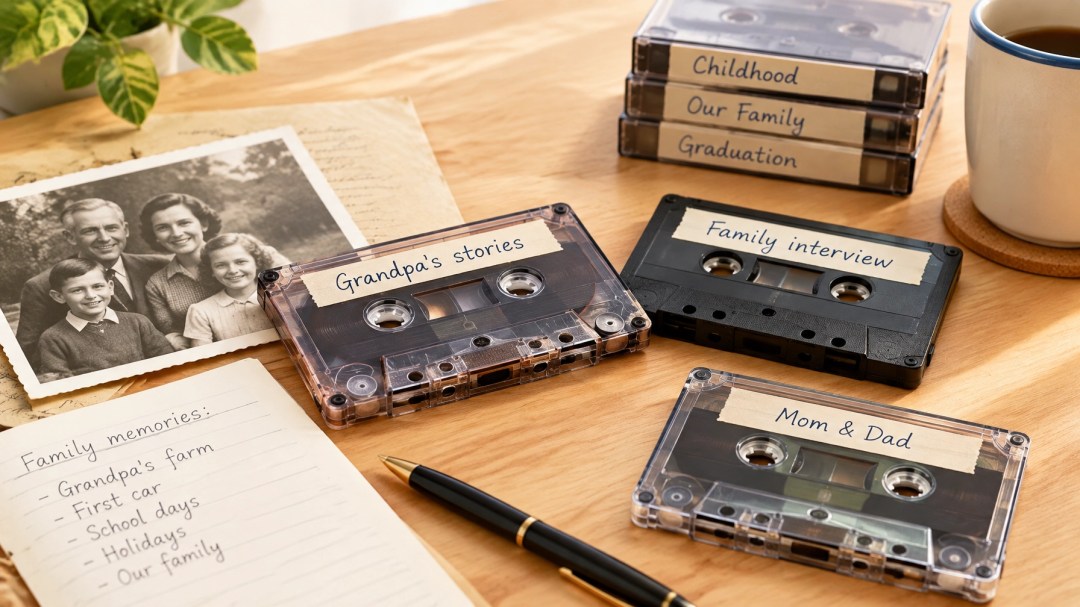
Why family interviews are worth keeping
A family interview is a record of both what someone remembers and how they express it. A relative might describe a first job, a childhood home, a holiday tradition, or the journey that brought the family together. Their voice adds warmth and personality to details that might otherwise exist only in a written timeline.
Interviews can also help relatives connect across generations. A grandparent’s account of growing up, for example, may give children and grandchildren a more vivid sense of family life before their time. Even a conversation that wanders between topics can reveal relationships, values, humor, and shared memories.
The Smithsonian’s overview of oral history describes it as a way to preserve people’s memories and perspectives through recorded interviews. For families, the same idea applies on a personal scale: a cassette can be a primary source for family history, carrying a person’s own account rather than a summary written later.
A voice holds details a transcript may miss
A transcript can help you find names and topics, but it cannot fully reproduce a voice. The rhythm of a sentence, a familiar expression, a spontaneous laugh, or the way someone tells a story all contribute to what makes a recording meaningful.
That does not mean every recording needs a formal transcript or a carefully planned listening session. Sometimes the value is simply being able to press play and hear a familiar voice. A digital copy makes that experience easier to share with relatives who do not have a cassette player or live nearby.

What to expect from professional cassette digitization
Cassette recordings are analog, and their playback depends on equipment designed for the format. As playback machines become less common, converting a recording to a current digital format is one practical way to keep it accessible. The Library of Congress explains that preserving personal audiovisual collections can include conversion and ongoing care of digital files.
When you choose a professional service, you can expect your original cassette to be handled as a meaningful family keepsake, not just as an item to process. A specialist service works with the original format and equipment suited to cassette playback. The goal is to create a listenable digital version of the recording while respecting the source material.
At Scan A Lot, we provide audio cassette digitization for customers who want to preserve and revisit the voices on their tapes. If you are unsure what format a tape is or what to expect from a particular recording, you can ask us about it before getting started.
Simple ways to make your recordings more meaningful
You do not need to prepare a complete family archive before digitizing a cassette collection. A little context can simply make the recordings easier to identify and enjoy later.
- Keep existing labels and notes with the tapes. A name, date, event, or location can help your family understand what they are listening to. If the label is unclear, you can note what you know separately.
- Preserve the context you remember. Even a brief note such as “Aunt Maria talking about her first apartment” can make a recording easier to recognize years from now.
- Include related materials where useful. Photographs or written notes from the same period may offer helpful context for family members listening later.
- Think about who might enjoy hearing the stories. Siblings, cousins, grandchildren, and other relatives may each connect with different parts of an interview.
- Keep the original cassette after digitization. The digital file makes listening and sharing more convenient, while the tape remains part of the family collection.
These are gentle organizing ideas, not requirements. If all you have is a cassette with an uncertain label, that is a perfectly reasonable place to begin.
From one cassette to a shared family story
Once an interview is available as a digital file, it becomes easier to listen together, share with relatives, or include in a family-history project. A recording can prompt questions and conversation: “Where was that house?” “Who else was there?” “Do you remember that story differently?”
Listening together can also be meaningful for older adults and people living with dementia or Alzheimer’s. Familiar voices and personal stories may offer opportunities for connection and reminiscence. Everyone’s experience is different, so it helps to let the listener guide the moment and choose whether they want to hear more.
A digitized family interview does not need to become a public project to matter. It may be for a small circle of relatives, a family gathering, or one person who wants to hear a loved one’s voice again. Having a convenient digital copy gives your family more options for how and when to listen.

Keep the story in their own words
The most memorable parts of family history are often the details that do not fit neatly into a timeline: a phrase a relative always used, the way a story changed slightly each time it was told, or the laughter in the room when everyone remembered the same moment. A cassette interview can hold these small but lasting pieces of family life.
Professional digitization gives you a convenient way to listen to those recordings with today’s devices and share them with the people who care about them. If you have family interviews on cassette and would like to learn more, contact Scan A Lot. We’ll be glad to help you understand the options for preserving your recordings.
#AudioCassetteToDigital #AudioCassetteDigitization #FamilyInterviews #FamilyHistory #OralHistory #FamilyStories #PreserveFamilyStories #FamilyVoices #PersonalHistory #FamilyLegacy #MemoryPreservation #AudioPreservation #CassetteTape #CassetteConversion #DigitizeMemories #DigitalPreservation #PreserveThePast #FamilyArchives #GenerationalStories #StoriesInTheirOwnWords #HearTheirStories #RecordedMemories #VoicesOfThePast #FamilyConnections #Reminiscence #MeaningfulMemories #ScanALot #ScanALotPhotos #MediaConversion #AudioDigitization #PreserveYourLegacy #FamilyKeepsakes #HistoryAtHome #ListenTogether #MemoriesForGenerations