

Some family memories are easy to recognize in a photograph. Others return through sound: a grandmother’s laugh, a parent telling a familiar story, children singing in the back seat, or a loved one speaking from a time when life looked very different.
Old audio cassettes can hold these moments with remarkable intimacy. Even when the recording includes tape hiss, room noise, or the gentle mechanical sound of the original equipment, hearing a familiar voice again can feel surprisingly immediate. For many families, an audio cassette to digital transfer is not simply a way to update an outdated format. It is a way to make family history accessible again.
At Scan A Lot, we help families preserve audio cassettes and reel-to-reel tapes as high-quality digital files that are easier to listen to, share, and protect for the future.
Categories: Tips & Tricks · Preservation
Why voices feel so personal
A photograph shows us how someone looked. A recording can remind us exactly how they sounded.
The pace of a person’s speech, the words they used, the way they laughed, and the small pauses between thoughts can all bring back details that may not be captured anywhere else. A short recording can restore a sense of presence in a way that written memories sometimes cannot.
You may find yourself hearing:
- A parent describing childhood memories
- A grandparent telling stories about family traditions
- Wedding vows or anniversary messages
- Children saying their first words
- A family member singing or playing an instrument
- Conversations recorded during holidays or reunions
- Oral histories, interviews, sermons, or messages from relatives
- Everyday moments that seemed ordinary at the time
These recordings do not have to be professionally produced to be meaningful. In many cases, their value comes from their honesty. The background sounds, imperfect volume, and natural conversation are part of the memory.
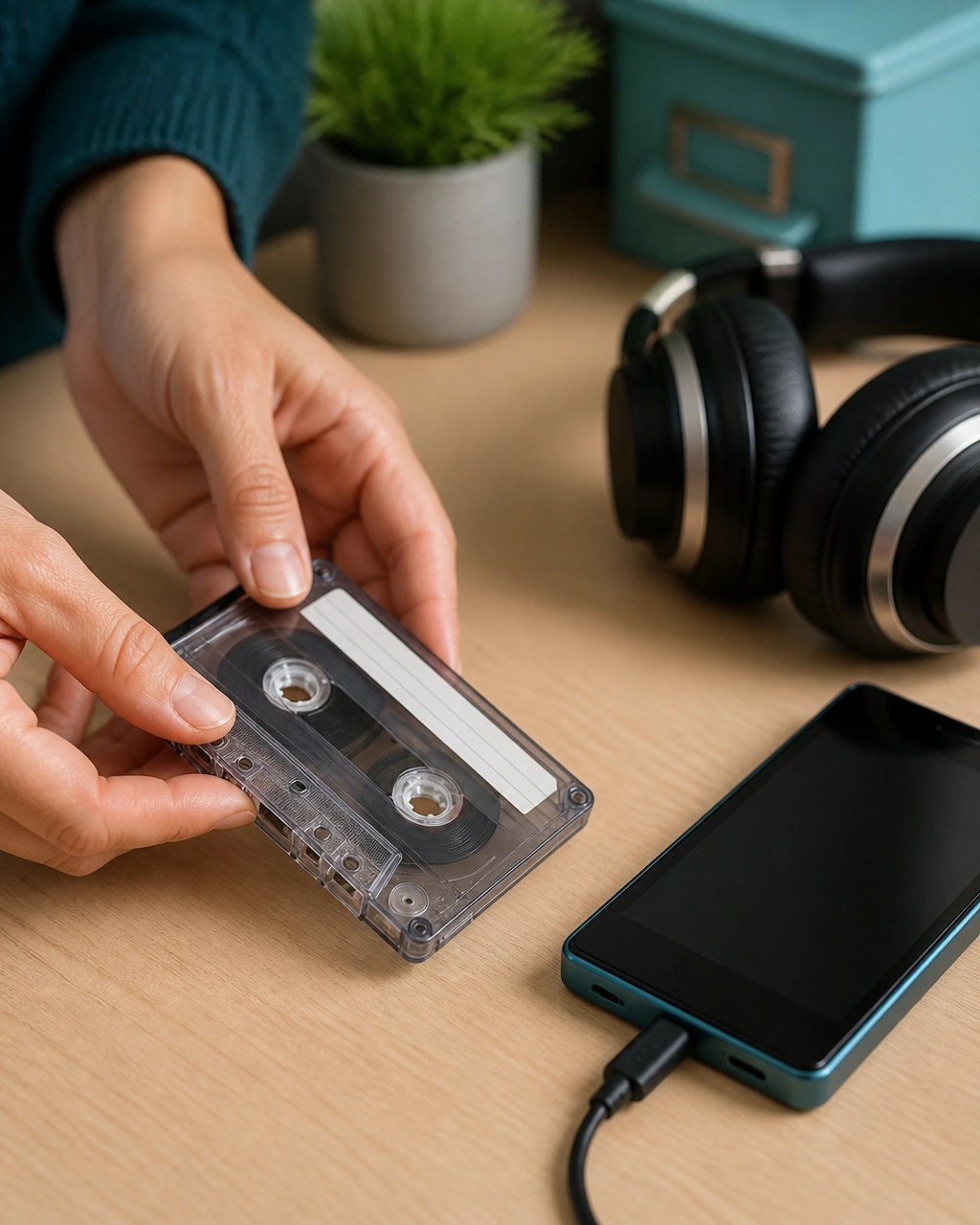
Audio cassette to digital makes family stories easier to revisit
Compact cassettes were convenient when they were new, but they are not as convenient to use today. Many families no longer have a reliable cassette player, and even a working player may not be suitable for delicate or aging tapes.
Digital files make the recordings much easier to access. Once your tapes have been converted, you can listen to them on a computer, tablet, phone, or other compatible device. You can also share copies with relatives who live in different homes or different states.
That accessibility can change how a family uses its archive. Instead of keeping a cassette in a box and wondering what it contains, you can:
- Listen to a favorite story without repeatedly playing the original tape
- Share a recording with siblings, children, or grandchildren
- Add audio to a family slideshow or tribute video
- Create private folders for different branches of the family
- Keep a copy in secure digital storage
- Use file names and notes to identify the people, dates, and events connected to each recording
The result is not just a collection of files. It is a family resource that can be revisited during holidays, anniversaries, reunions, and quiet moments at home.
Preserving more than the sound
A professional transfer aims to preserve the recording as faithfully as possible. That means the goal is not to make every tape sound artificially new. The goal is to capture the information that remains on the original cassette clearly and carefully.
Magnetic tape can change with age, storage conditions, and repeated playback. The tape may become brittle, lose tension, or develop physical problems that make playback more difficult. The cassette shell, pressure pad, and internal components can also affect how smoothly the tape plays.
Research from cultural heritage organizations, including the Canadian Heritage Information Network’s audio digitization guidance, emphasizes the importance of appropriate playback equipment, accurate capture, quality review, and preservation-minded file formats.
A careful professional process may include:
- Inspecting the cassette before playback
- Identifying visible damage or unusual conditions
- Using maintained, professional broadcast-grade equipment
- Monitoring the recording during playback
- Capturing the audio in real time
- Creating high-quality digital files
- Providing practical listening copies for everyday use
- Keeping the original recording represented as faithfully as possible
As Duke University Libraries has explained in its discussion of cassette digitization, a 90-minute cassette takes approximately 90 minutes to capture because audio transfer is a real-time process. That time allows the recording to be monitored instead of treated as a quick, one-button conversion.
When a familiar voice can provide comfort
For families supporting someone living with dementia or Alzheimer’s disease, old audio recordings may have a special role in reminiscence activities.
Familiar voices, songs, and stories can sometimes encourage conversation, recognition, or a feeling of comfort. A recording of a spouse, parent, sibling, or close friend may offer a reassuring connection to the past. Listening may also create an opportunity for caregivers and relatives to talk about people, places, and events connected to the recording.
Every person responds differently, and audio recordings are not a substitute for professional medical care. However, they can become a meaningful part of a personalized memory-care routine when used in a calm, supportive setting.
A digital format can make this easier because the recording can be played from a simple device without searching for an old cassette deck or handling the original tape. A caregiver may be able to create a small playlist of familiar voices or songs, with notes explaining who is speaking and when the recording was made.

The emotional value of everyday recordings
Families often expect their most important tapes to contain major events. Sometimes they do. But a recording does not need to document a milestone to become precious.
A few minutes of conversation in a kitchen may preserve a person’s personality better than a formal interview. A child’s voice may bring back a specific season of family life. A casual message recorded for a relative may become more meaningful with every passing year.
The context may also return gradually. One family member may recognize the speaker. Another may identify the location. Someone else may remember what happened before or after the recording. Digitizing the collection gives everyone a chance to contribute to its story.
This is one reason it helps to keep any existing labels, notes, or written information with your tapes. Even a simple label such as “Christmas 1987” or “Grandpa’s stories” can help relatives understand what they are hearing. If the label is unclear, Scan A Lot can still help you discuss the best way to organize the collection before the transfer.
What file options should families expect?
Most families benefit from receiving files that are convenient for everyday listening, along with a high-quality preservation file when appropriate.
A larger, less-compressed file can serve as an archival master, while a smaller file may be easier to share with relatives or play on common devices. The right delivery format depends on the recording, the intended use, and how you plan to store the files.
It is also helpful to keep more than one copy. Consider saving your completed files in at least two locations, such as an external drive and a trusted cloud-storage service. You may also want to give a copy to another family member. Digital preservation works best when files are organized, backed up, and checked from time to time.
For additional preservation ideas, Scan A Lot’s digitization tips offer guidance for caring for converted family media.
A careful path from cassette to digital file
You do not need to know the technical history of every cassette before contacting a service. You also do not need to listen to every tape first, especially if you are concerned about playing an irreplaceable recording on old equipment.
Start by gathering the tapes you know are important. Keep them in their cases when possible, and make a note of any labels, names, dates, or special concerns. If you see mold, a cracked shell, loose tape, or other visible damage, mention it before playback.
Scan A Lot handles audio cassettes and reel-to-reel tapes with care as part of our broader audio cassette digitization service. Our work is completed in our own West Hempstead lab rather than being sent to a third party. We serve local families through drop-off appointments and also offer options for customers who need to mail their media.
The process begins with a conversation about your collection, the recordings you want preserved, and how you would like to receive the finished files.
Hear your family’s voices again
There may be a voice on one of your old cassettes that you have not heard in years. It may belong to someone you miss, someone your children never had the chance to know, or even an earlier version of yourself.
An audio cassette to digital transfer can make that recording easier to reach while helping protect the original from unnecessary handling. More importantly, it can turn a forgotten tape into a shared family experience.
If you have audio cassettes or reel-to-reel tapes waiting in a closet, contact Scan A Lot to discuss your project. You can also call 844-SCAN-PIX (844-722-6749) or email sales@scanalot.photos. We will help you understand the next step and handle your recordings with the care they deserve.
#AudioCassetteToDigital #AudioCassetteDigitization #FamilyVoices #PreserveFamilyMemories #MemoryPreservation #FamilyHistory #OralHistory #AudioTransfer #DigitizeMemories #CassetteTape #VintageAudio #DigitalArchives #FamilyLegacy #ReminiscenceTherapy #DementiaSupport #AlzheimersCare #MemoryCare #GrandparentsVoice #VoicesOfThePast #StoriesThatMatter #HeirloomPreservation #AnalogToDigital #AudioPreservation #FamilyRecordings #LegacyProject #ShareFamilyHistory #PreserveThePast #ScanALot #MediaConversion #LongIslandDigitization #WestHempstead #PreciousMemories #HearItAgain #PreservationMatters